Working But Not Housed: The Reality of Hidden Homelessness in Canada
I wrote this self-directed narrative feature based on a fictional composite character experiencing hidden homelessness. Inspiration, information, and statistics have been drawn from publicly available sources that report on hidden homelessness in Canada. View sample campaign elements (Facebook post) following the article on this page.
Nadia is a single parent to a teenage son. As her workday comes to a close, she leaves the office, gets into her car, and drives to pick up her son from school. Her stomach is tight. When her son gets into the car, he looks agitated. Neither speaks very much. Together, they return home. But “home” is not what it was just one month before.
Now, home is in a friend’s living room, where Nadia and her son have been staying after receiving an eviction notice a few weeks earlier. Unable to find another affordable rental option, they were grateful when a friend opened his doors.
While Nadia has a job, her work hours have recently been reduced. When her landlord increased the rent, the financial pressure was too much to manage. She fell behind on rent payments, which triggered a formal eviction.
The displacement, which forced Nadia and her son to squeeze their lives into the space of a living room, is taking a toll. Both are feeling anxious about the future. Both miss the privacy they once had in their own home, with their own separate bedrooms. Nadia knows the current arrangement is only temporary. She knows she must find a place to live quickly.
Her son does his homework on the pull-out sofa bed they share in the living room. And she, after a long day at work, continues the arduous search for housing.
Hidden Homelessness: A Growing Concern for Canadians
Nadia and her son are experiencing hidden homelessness, a situation in which people must temporarily live with family, friends, in their car, or in any other sheltered place because they don’t have a stable, permanent home. Hidden homelessness often goes unseen because those going through it are not living outside or in shelters.
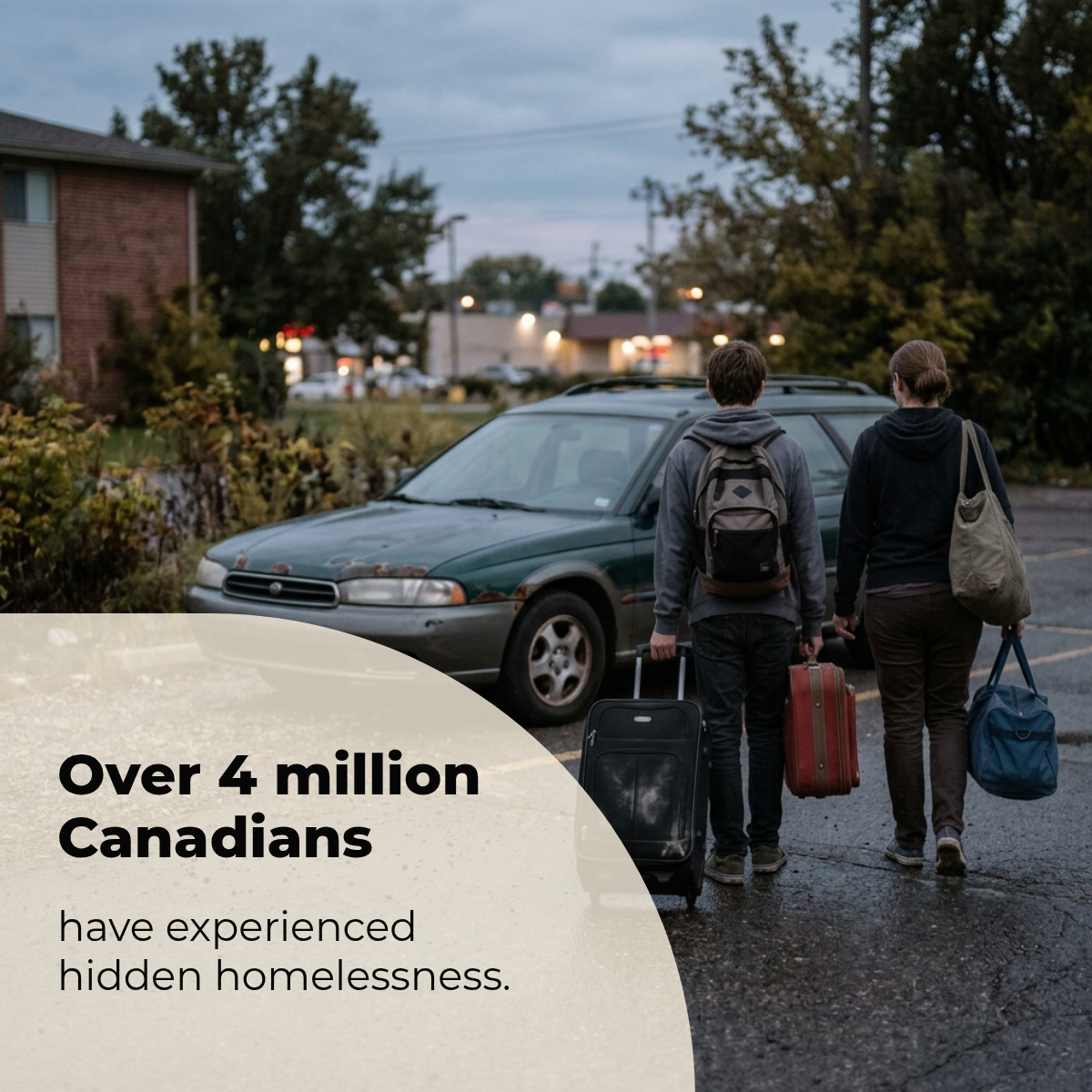
Experiences like Nadia’s are becoming more common. According to Statistics Canada, 11.2% of Canadians (around 4.3 million people) reported experiencing hidden homelessness at some point in their lives. Rates of housing instability and homelessness, including hidden homelessness, are increasing in Canada.
The Hunt for Stable Housing: Rentals, Subsidized Housing, or Shelters
In her friend’s living room, Nadia’s search for rental housing is anything but straightforward. She encounters higher rental prices than she can afford. The lower-cost units are competitive, and as soon as she comes across a viable option, it seems to disappear off the market.
So she makes concessions. She adjusts her search criteria to even lower-cost options. She expands her search radius and even considers units that are of a lower quality than she would prefer. She submits many applications, but isn’t chosen for any of the units she applies for.
Nadia feels an increasing urgency to find a solution. With her options dwindling, she decides to try accessing subsidized housing. But doing so while balancing a full-time job and caring for her son feels nearly impossible. While she can apply for subsidized housing programs online in the evenings, she can only speak to a real person during daytime hours. This makes it difficult for Nadia to move through the application process without it interfering with her workday and ability to be present for her son.
Disconnected subsidized housing systems further complicate the situation. Nadia doesn’t fully understand how each system operates or approves applications. Different agencies refer her to different housing intake programs. She calls housing lines on her lunch breaks, but often waits on hold the entire time, only to have to try again the next day.
Nadia is wary about entering the shelter system with a teenager, where safety and privacy aren't guaranteed. She wants a place where her son can live as normally as possible so he can focus on his schoolwork, hobbies, and social life. So she delays contacting shelters and instead puts all her efforts toward securing an affordable rental or subsidized housing.
After several weeks of staying with her friend, the arrangement comes to an end. Nadia and her son must find someone else to stay with while the search for a stable home carries on.
Taking All the Right Steps, But Housing Instability Continues
This is what the cycle of hidden homelessness looks like. After a housing loss, people couch surf with friends, family, or colleagues. They try to find housing in an expensive and competitive rental market, or through complicated subsidized systems. When one temporary housing option expires, the individuals have no choice but to pick up and move to the next one. Both affordability and fragmented subsidized housing systems are primary causes of ongoing homelessness.
Affordability Factors
For many Canadians, housing and rental costs consume more than 30% of their income. This exposes them to the risk of housing loss if unexpected costs or debts pile up. If they don’t have enough savings, they can lose their home and be forced into a rental market that is nearly impossible to re-enter at the same price point. Organizations like Canada Mortgage and Housing Corporation have stated that affordability is a primary cause, and not just an associated factor, of homelessness in Canada.
Effects of System Fragmentation
There is no single entry point to apply for subsidized housing. Programs are provided through agencies, programs, and different levels of government that operate separately. People must deal with different applications and eligibility criteria at a time when they are already overwhelmed.
Not only that, they often have to tell their story repeatedly to different providers. People commonly interact with several agencies before being placed into appropriate subsidized housing, or even onto the right waitlist.
Eligibility criteria may also exclude certain people from accessing support. Reasons include falling into a higher income bracket, having older children or no dependents, or being unable to produce the documents a provider needs to open an application. Applicants may end up on a different wait list for each agency they interact with. They remain uncertain of their position or how long they will have to wait.
Despite doing all the right things, those looking for stable housing can often wait for months or even years. People experience increasing stress from the repeated moves, and far too often, there is no end in sight.
When a Stable Income and Existence of Support Aren’t Enough
As Nadia’s story shows, even working people with a reliable income can be thrust into homelessness. Despite ongoing efforts to find a permanent home, people can remain stuck in temporary arrangements for a long time.
The support systems that do exist don’t work together, have limited capacity, and are often overwhelming to deal with. And crucially, support systems move slowly relative to the urgency of the need.
Nadia’s story represents a reality that over 4 million Canadians have experienced at some point in their lives. The individuals and families caught in the cycle of housing instability have no clear exit point. They must deal with ongoing moves between short-term arrangements for as long as it takes to find a place of their own again.
People like Nadia need consistent coordinated support to enable housing stability as soon as possible. You can help by funding a housing navigator to connect someone to the right program faster.
Your support helps:
Coordinate applications across multiple housing providers.
Secure required referrals and documentation.
Match people with eligible programs.
Track openings so people can act quickly when units become available.
Help people like Nadia exit the cycle of hidden homelessness. Fund a housing navigator today.
My Approach
I wrote this piece with three goals:
That readers relate to Nadia and understand homelessness can happen to anyone, even someone like them.
That they learn how wider systemic issues create the conditions for homelessness. And that being unhoused is not a personal failure on the part of the individual.
That readers feel the frustration that Nadia feels as she tries to find a permanent home. Then direct this frustration toward meaningful change by participating in the (fictional) call-to-action at the end of the article.
The content is structured to bring readers along with Nadia’s experience of hidden homelessness, and then zoom out to highlight the deeper causes of her situation. A grade 9 reading level and clear headings make the piece accessible and scannable for diverse audiences.
AI Disclosure: I wrote and edited this piece’s body content. ChatGPT was used to assist with research, prioritizing information, and content structuring. The title and some subheadings were AI-generated.
Sample Campaign Elements
Facebook Post
*AI-generated image of mother and son walking to their car.
Copy
This is what the cycle of hidden homelessness looks like:
A family loses their home
Finds a temporary place to stay
And then continues moving from one place to another
For weeks, months, or even years until they find a home of their own again.
Ask around. You may know someone who’s gone through it.
Read our full feature about how hidden homelessness impacts Canadians: https://hollythomson.ca/hidden-homelessness